You’re not addicted to betting.
You’re addicted to the four seconds before you find out you lost.
From Ignatius Odongo, a Nigerian engineer, who spent two years losing this fight before he found the actual mechanism behind it.

Founder, Project Transformed
Ignatius Odongo Engineer, Mental Health Advocate
You know that feeling.
The match is about to start, and your hands are steady for once — because this time, this time, you did your research. You checked the odds. You watched the highlights. You told yourself, this one is different.
It isn’t different. It’s never different. But for those ninety minutes, you are the most alive version of yourself. Nothing else exists. Not the rent. Not the argument with your wife last night. Not the loan you took “just to top up” three weeks ago that you still haven’t told anyone about.
Then the final whistle blows, and the silence after is the loudest sound in the world.
You tell yourself this is the last time. You’ve told yourself that before, after the ₦50,000 you lost the week your daughter started JSS1, after the salary that disappeared before the 15th, after the night you sat in your car outside your own house because you couldn’t face your wife’s eyes.
You’re a good man. A working man. Maybe an engineer, a teacher, a driver, a civil servant, somebody who wakes up early, who prays, who genuinely loves his family. And still, somewhere between your BVN and your bet slip, a part of you keeps disappearing.
This isn’t about willpower. You have plenty of that, you use it every day to survive Lagos traffic, to meet deadlines, to keep smiling when things are hard. This is about something else entirely. Something nobody has explained to you properly. Not your pastor. Not your friends. Not even the counsellor you were too ashamed to actually go and see.
Here’s the part that changes everything once you understand it.
Betting doesn’t hook you with money. It hooks you with uncertainty.
Your brain runs on a chemical called dopamine, and most people assume dopamine is released when you win. It isn’t, really. The biggest spike doesn’t come from winning at all, it comes from the not knowing.
The seconds between placing the bet and seeing the result are the most chemically active moment in the entire cycle. Researchers call this a reward prediction error, your brain lighting up not because something good happened, but because something might.
This is why a near-miss can feel almost as exciting as a win. Your team leading until the 89th minute, then losing 2 to 1. Your brain doesn’t cleanly separate “almost” from “yes.” It just registers: close, try again, maybe next time.
And here’s the part that will make your stomach drop: the apps know this. Every notification, every “your odds have increased,” every free bonus that lands exactly when your balance hits zero, none of it is random.
It’s engineered, by people who have studied precisely how your brain works, to keep that loop of uncertainty running for as long as it possibly can.
That’s why “just stop” has never worked for you. You weren’t fighting a bad habit. You were fighting a system, built by behavioural scientists, funded by billions of naira, designed specifically to be harder to walk away from than a cigarette or a drink.
Once I understood this, that my brain wasn’t weak, it was targeted, everything changed. I stopped trying to out-willpower a system built by people smarter than both of us on this exact problem.
I started rewiring the actual loop the addiction lives in instead. That’s the whole difference between quitting for three days and quitting for good.
My name is Ignatius Odongo. I’m 31, a Nigerian, and I’m an engineer.
For two years, betting quietly ran my life while I told everyone, including myself, that I had it under control.
How it started
It started small, the way it always does. I was 28, newly starting out at a production company somewhere in Cross River State, living alone for the first time, with a decent allowance and a lot of empty evenings.
A colleague, Esther, showed me how to stake a virtual game on a Saturday afternoon. ₦500 on Aviator. I won ₦4,200.
I remember exactly how that felt, like I had found a small, private superpower nobody else knew about. And having just lost over ₦2 million to forex months earlier, desperate for any way to recover it, I saw this as something close to a miracle.
Within four months, ₦500 became ₦80,000. Esther drifted away from it, she could genuinely take it or leave it. I couldn’t. I didn’t understand, back then, that her brain and mine weren’t reacting to the same trigger the same way. I just thought I was better at picking matches than she was. I wasn’t. I was just more hooked.
What it cost me
By my second year, I was staking almost every day. Football, then virtual football, then, on the really bad nights, any virtual game.
I told myself I was “investing.” I built spreadsheets. I convinced myself that if I was disciplined enough, methodical enough, I could turn it into a second income.
That belief cost me more than any single bad bet ever could, because it meant I never once thought of myself as someone with a problem. Problem people were reckless. I was “strategic.”
The truth crept up on me the way water rises in a boat with a slow leak. You don’t notice until you’re ankle-deep and it’s already too late to bail fast enough.
By the end of year two, I had borrowed ₦900,000 from a cooperative society at my site, telling them it was for my younger sister’s school fees. I paid it back slowly, always a month behind, always a new excuse. I was owing FairMoney, OKash, PalmPay, EasyMoni, PalmCredit, and other digital money lenders huge amounts, with the interest compounding every week.
My mother would always call to check up on me, and each time I told her things were “fine, fine” while I was eating garri and groundnut for dinner because my salary had gone into a 3-odds accumulator that lost in the 87th minute of the last match.
I lost my girlfriend, Blessing. Not in one dramatic fight. In a hundred small ones. She found out about the cooperative loan before I told her myself, from a colleague who mentioned it in passing at a wedding.
“You let me hear it from somebody else,” she said, and I had no answer, because there wasn’t one that didn’t sound like a lie.
We stayed together another six months, mostly out of habit and hope, before she finally said what we both already knew. “I can’t build a life with a man who’s competing with a betting app for his own money.”
My health went too, though I didn’t clock it as related at the time. I stopped sleeping properly, checking odds at 1am, 2am, arguing with myself about whether to place “just one more” before bed.
My blood pressure, at 29, was already something my doctor frowned at during a routine site medical. He asked, gently, “Any particular stress in your life right now?” I said no. I genuinely didn’t connect the two.
What I tried, and why none of it worked
- Deleting the apps. I did this at least six times. Every single time, they were reinstalled within two weeks, because deleting an app does nothing to the loop running in your head. The urge doesn’t live on your phone. It lives in your nervous system.
- “Small stakes only.” I set myself a rule, ₦200 max per bet. It lasted nine days, until I told myself an accumulator “technically” counted as one bet, even with six selections and a ₦40,000 payout if it hit. It didn’t hit.
- Giving my ATM card away. I handed my card to my friend Daniel and told him not to give it back no matter what I said. Three days later I opened a new account with a different bank using my phone, purely for betting, and never told him. He still doesn’t know.
- Church and prayer alone, with no practical system behind it. I want to be careful here, because my faith carried me through the hardest parts of this, genuinely. But prayer without a daily structure gave me willpower for the moment I was praying, and nothing left over for 11pm on a Tuesday when the urge hit and I was alone with my phone.
- “Replacing” betting with crypto trading. This is the one I’m most ashamed of, because I told myself it was the mature, responsible upgrade. It wasn’t. It was the same dopamine loop wearing a suit. I lost more in four months of impulsive trades than I had in the previous year of betting combined.
The night it broke
By the start of my second year, I was staking almost my entire net pay most months, then borrowing against the next month to survive, then ending up staking most of that too.
I remember one specific night, a Tuesday, I still remember the date, sitting on the floor of my room in Calabar at 2:47am, having just lost ₦380,000 on a match I hadn’t even watched.
I thought, clearly, for the first time: I am going to lose everything. My career, my family’s trust, maybe my life, to a phone app.
The turning point
That week, I didn’t go to a doctor or a priest first. I went to my company’s site clinic for an unrelated headache, and the nurse on duty, an older woman named Mrs. Jacinta, asked, almost casually, why I looked like I hadn’t slept in a week.
Something about the way she asked, without judgment, cracked something open in me. I told her. All of it. It was the first time I had said the words “I think I have a betting addiction” out loud to another human being.
She didn’t lecture me. She said one thing I’ve never forgotten: “Ignatius, you don’t need more discipline. You need a different system, because the one you’re using was never designed to help you win.”
That sentence sent me down a rabbit hole. I started reading, properly reading, the way I used to study for my engineering exams, about behavioural psychology, dopamine, habit loops, and how real recovery programs rewire behaviour instead of just leaning on willpower.
I wasn’t looking for motivation quotes anymore. I was looking for a mechanism.
Over the following months, combining what I learned with real trial and error on myself, as an engineer, I couldn’t help but treat it like a system to debug, I built a structured, day-by-day process. Not “just stop.” A sequence: identifying my specific triggers, breaking the uncertainty loop on purpose, rebuilding my relationship with money and risk, and putting real accountability around myself so I was never fighting this alone at 2am again.
I tested it on myself first, for a full 21 days, tracking everything. By day 21, for the first time in two years, I went a full week without a single urge strong enough to make me open a betting app. Not because I was being strong. Because the loop itself had changed.
I’ve now been betting-free for over a year. I’ve been rebuilding my savings.
I built this program because Mrs. Jacinta was right. I didn’t need more discipline. I needed a system. And once I built mine, I couldn’t keep it to myself, knowing how many men out there are exactly where I was, at 2:47am, thinking there’s no way out.
There is a way out. I found it. Now I want to hand it to you.
The 21 days, honestly laid out.
Trigger mapping
You identify your personal trigger map, the exact times, emotions, and situations that push you toward staking. Most people are shocked to see the pattern in black and white for the first time.
The restlessness eases
The physical urge, the phone-checking, the racing thoughts, starts measurably dropping as your first “loop interrupt” habits take hold.
First check-in
A personal message from me directly, reviewing how the first week actually went for you. No live call needed here, just a real human on the other end at the point most people slip.
The quiet mind phase
Evenings that used to be consumed by odds-checking start to feel unfamiliar. Some describe it as boring at first, then relieving.
First live call
You join me directly for your first live call, reviewing real progress against your tracking grid, adjusting your trigger list, and reinforcing whichever rewiring habits are working best for your specific pattern.
A full week, clean
Most people report their first full week with zero urges strong enough to open the app. Sleep improves. Small, physical, undeniable proof that something has shifted.
Second live call & protocol complete
Your second live call session with me. You now have a permanent, personal system, not a temporary streak, for staying free going forward.
Cashing Out, My War With Betting, And How I Won
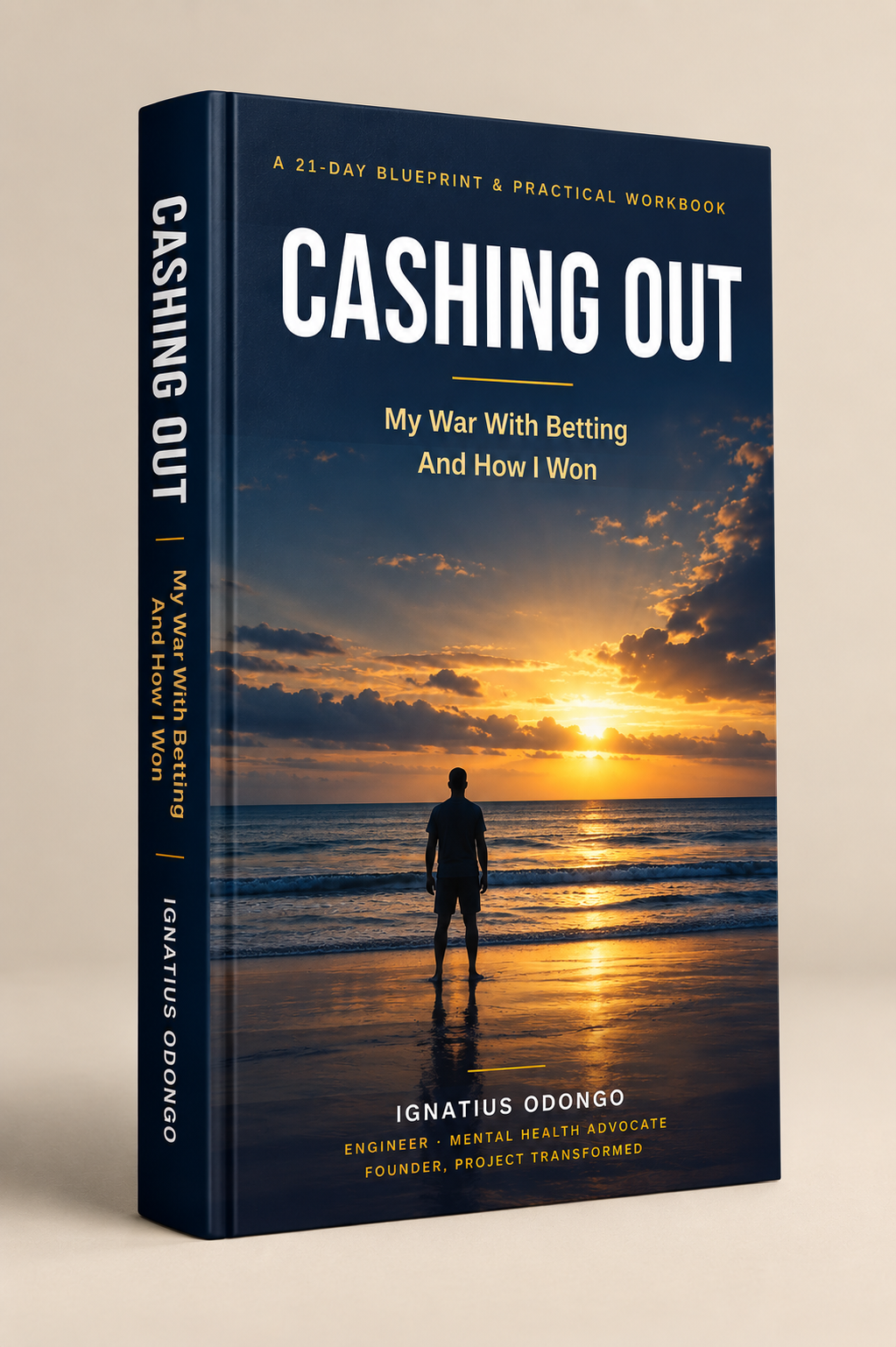
A 21-day blueprint & practical workbook
This isn’t a motivational pamphlet. It’s the complete, day-by-day system I used to break a two-year betting addiction, written exactly the way I wish someone had handed it to me at 2:47am on that floor in Calabar.
Inside the workbook:
- Introduction
- Ch. 1, The Four Seconds: What’s Actually Happening In Your Brain
- Ch. 2, My War, Unfiltered
- Ch. 3, Mapping Your Loop
- Ch. 4, Why “Just Stop” Was Never Going to Work
- Ch. 5, The Loop Interrupt Method
- Ch. 6, The 21-Day Protocol: Days 1 to 7, Mapping Week
- Ch. 7, The 21-Day Protocol: Days 8 to 14, Interrupting Week
- Ch. 8, The Loop Interrupt Toolkit
- Ch. 9, The 21-Day Protocol: Days 15 to 21, Consolidating Week
- Ch. 10, Rebuilding Trust: Money, Marriage & Family
- Ch. 11, If You Slip: The Relapse-Proofing Protocol
- Ch. 12, Your 90-Day Maintenance Plan
- Closing
Every page is built from what actually worked on me, not theory borrowed from a textbook. A tested, lived, engineered system.
You are not the only one fighting this.
By Day 14 I had gone a full week without checking odds once. I did not think that was possible for me.
The trigger mapping in Chapter 3 was the first time anyone explained why I always slipped at the same time every night.
The Day 14 and Day 21 calls were the first honest conversations I had ever had about this, with no judgment attached.
I have tried quitting five times before. This is the first time it actually held past a month.
Three things I’m including, and why each one matters.
Bonus 1, Mindset Rewiring Library
Value ₦21,000Two carefully chosen books plus a workbook, to help you rebuild a healthy relationship with money, how to think about earning, saving, and risk without the false promise of a quick win. These are the exact reads that helped me stop seeing money as something to gamble and start seeing it as something to build.
Bonus 2, Two Live Calls, Plus Check-In
PricelessOn Day 14 and Day 21, you’ll join me directly for two honest, unscripted calls, no judgment, just where you are and what needs adjusting. In between, on Day 7, you’ll get a personal check-in message from me directly, at the exact point most people slip. This is the same kind of conversation Mrs. Jacinta gave me, spaced across the days you actually need it.
Bonus 3, Private Support Group
PricelessYou’ll be added to a group of men walking the exact same road, sharing real progress, real setbacks, and real wins, anonymously and without shame. Addiction thrives in silence. This is what breaks it.
Everything, laid out plainly.
| Cashing Out, Full PDF Program | ₦20,000 |
| Bonus 1, Mindset Rewiring Library | ₦21,000 |
| Bonus 2, Two Live Calls + Check-In | Priceless |
| Bonus 3, Private Support Group | Priceless |
| Total value | ₦36,900+ |
| Your commitment fee today | ₦8,990 ₦20,000 |
My 60-day, results-or-refund promise.
I’m not asking you to trust a stranger’s marketing. I’m asking you to trust a system that pulled me out of exactly what you’re going through, right now, tonight.
Go through the full 21-day protocol. Show up to your call and check-ins. Use the worksheets honestly.
If, after 60 days, you don’t feel a real, measurable shift in your relationship with betting, send one email to admin@transformd.online and I will refund every naira. No interrogation, no guilt trip, no hoops to jump through.
I’m not afraid to guarantee this, because I watched it work. On myself, first.
Two ways tonight can end.
The next 21 days are going to pass either way. The only question is which version of you is standing on the other side of them.
P.S.Remember, this comes with a full 60-day money-back guarantee. You aren’t risking anything by starting today. You’re only risking more time by waiting.
P.P.S.Enrolment is capped at 30 people per intake, because I personally check in on everyone myself. Once those spots are gone, the bonuses close and the price returns to ₦20,000.
P.P.P.S.I know exactly what tonight feels like for you, because I lived it for two years. You don’t have to keep living it. Cash out, for real this time.